
wild goose qigong
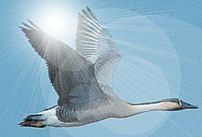 Wild goose qigong, also known as dayan qigong, is a traditional qigong form
said to be over 1800 years old and created by daoist monks living in the
sacred mountains of Kunlun on the border of northern Tibet.
Wild goose qigong, also known as dayan qigong, is a traditional qigong form
said to be over 1800 years old and created by daoist monks living in the
sacred mountains of Kunlun on the border of northern Tibet.
qigong healing and hypnosis
combine qigong and hypnosis to master techniques
Shaolin qigong course
Improve with just 15 minutes a day. Build experience week by week .
Free qigong course
Discover Master qigong and tai chi with this powerful
course. Sign up for free sample lessons...
The monks are said to have combined the movements of the wild goose, famed for its grace, strength and longevity, with their knowledge of the energy pathways in the body to create a form which is highly valued for its health benefits.
In 1980 Grandmaster Yang Meijun, the 27th lineage holder of the wild goose qigong system, (based in China) decided that the time for secrecy was past and that everyone should be able to experience the health benefits of dayan qigong for themselves.
On her 80th birthday she announced her decision and since then the Chinese government has promoted wild goose qigong as a safe and healthy exercise for all. It has become one of the most popular qigong forms in China.
The form has a wide variety of movements ranging from slow, fluid and gentle to quick and strong emulating the soaring, flapping, fluttering and spiralling graceful movements of the beautiful geese.
Dayan qigong is a comprehensive system with as many as many as 72 forms of which 11 movement forms and 7 meditation techniques were published by Yang Meijun. Its said some others are in the process of being documented and published - so we'll just have to wait.
The first 2 wild goose sets seem to be the most well known and easy to fit into a busy schedule taking about 10-15 minutes for each set.
The first set is designed to work on the energies created, and blocked, by your current lifestyle and the second set works on the factors and tendencies that you inherited from your parents.
If you choose to do the 2 sets together we're told that it is better to do the first set 1 2 or 3 times and then go straight into the the second set.
Unfortunately my attention was elsewhere when the explanation of why this is so was given!. If you know please share...
Having said that, at a recent (aug 2008) workshop in the UK Dr Hu recommended that beginners should start with wild goose 4 - Spiral and Tripod.
Having done it I think he's right - its a lovely introduction to wild goose qigong principles.
For an overview of the parts of the wild goose system released so far take a look here